Many organizations assume that larger teams create broader collaboration and better decisions. In practice, oversized teams often produce the opposite effect: weaker accountability, more cautious communication, and less meaningful interaction.
The problem usually develops gradually. A team starts small enough for direct discussion and shared ownership. Then additional stakeholders get added for visibility, alignment, expertise, or inclusion. Over time, the meeting becomes crowded, conversations become controlled, and genuine collaboration quietly disappears.
I find this distinction important because large teams rarely look dysfunctional on the surface. Meetings still happen. Updates still get shared. Decisions still move forward eventually. But the behavioral quality of the team changes dramatically once the group grows beyond the point where direct interaction feels psychologically safe and operationally manageable.
Why Team Size Changes Behavior More Than Leaders Expect
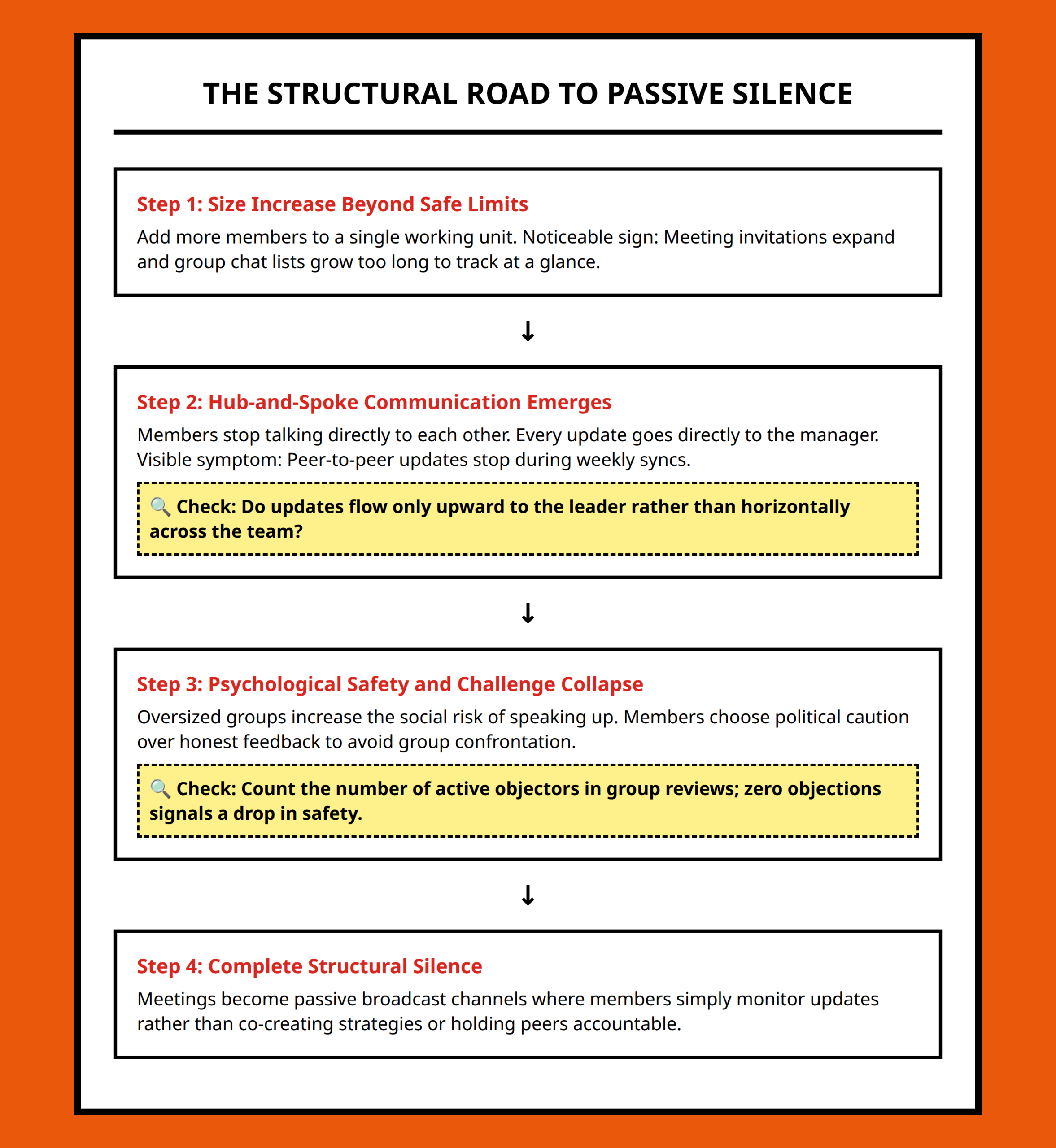
As teams become larger, communication patterns shift almost automatically. People become more selective about when they speak, how directly they challenge ideas, and how openly they express disagreement.
This is not necessarily caused by fear or incompetence. It is often a predictable response to social complexity.
In small groups, individuals usually feel visible. Their contributions matter. Silence becomes noticeable. Accountability feels personal.
In large groups, the opposite often happens:
- people speak less frequently
- responsibility becomes diffused
- participants observe more than contribute
- disagreement feels politically riskier
- meetings shift toward status reporting
Once that pattern appears consistently, the team stops functioning as a collaborative unit and starts functioning as an audience around a central coordinator.
Example: The 18-Person Leadership Meeting
Imagine a weekly leadership meeting with department heads, project leads, operations managers, and senior specialists all attending together.
Technically, everyone is present for collaboration. In reality, most participants speak only during their assigned section. Difficult disagreements get postponed into smaller follow-up conversations afterward because public challenge feels inefficient or uncomfortable in a crowded room.
The meeting still appears productive externally, but collective thinking becomes increasingly shallow.
How Oversized Teams Create Manager-Centered Communication
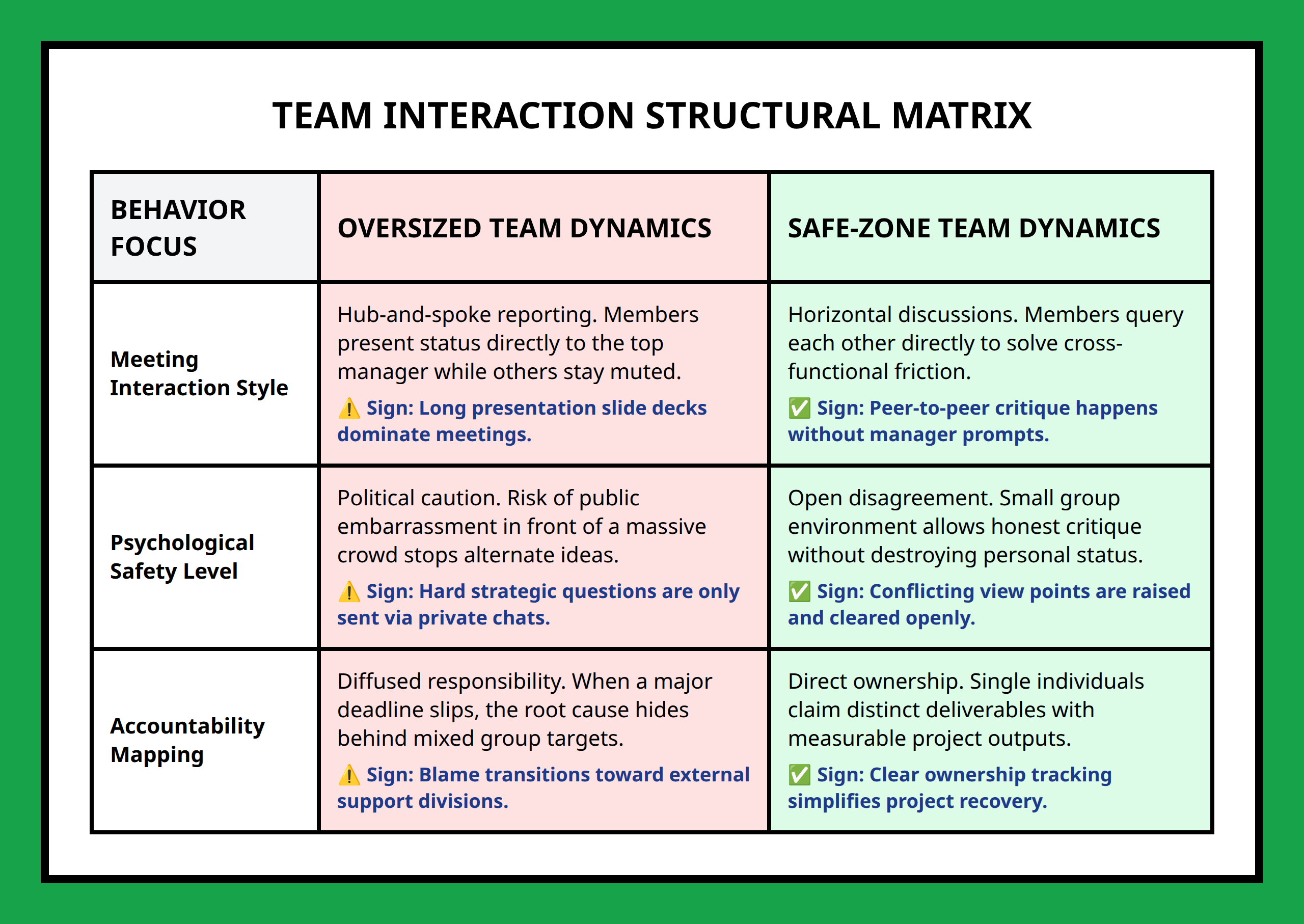
One predictable outcome of large teams is the emergence of hub-and-spoke communication patterns.
Instead of team members interacting directly with one another, nearly all communication flows through the leader. The manager becomes the central processing point for updates, approvals, questions, and coordination.
This creates a subtle but important structural problem.
The team may appear connected because everyone communicates with the manager, yet actual peer-to-peer collaboration remains weak.
I would think about it this way: when a leader becomes the communication bridge for every interaction, the team behaves less like a network and more like a broadcast system.
That distinction matters because collaboration quality depends heavily on lateral interaction between members, not just vertical reporting upward.
| Smaller Collaborative Team | Oversized Manager-Centered Team |
|---|---|
| Direct peer discussion | Leader-mediated interaction |
| Shared accountability | Centralized accountability |
| Open challenge | Cautious participation |
| Collective problem-solving | Sequential reporting |
| Active contribution | Passive observation |
Once meetings drift toward hub-and-spoke dynamics, team intelligence usually declines even if individual expertise remains high.
Why Honest Conversation Declines in Large Groups
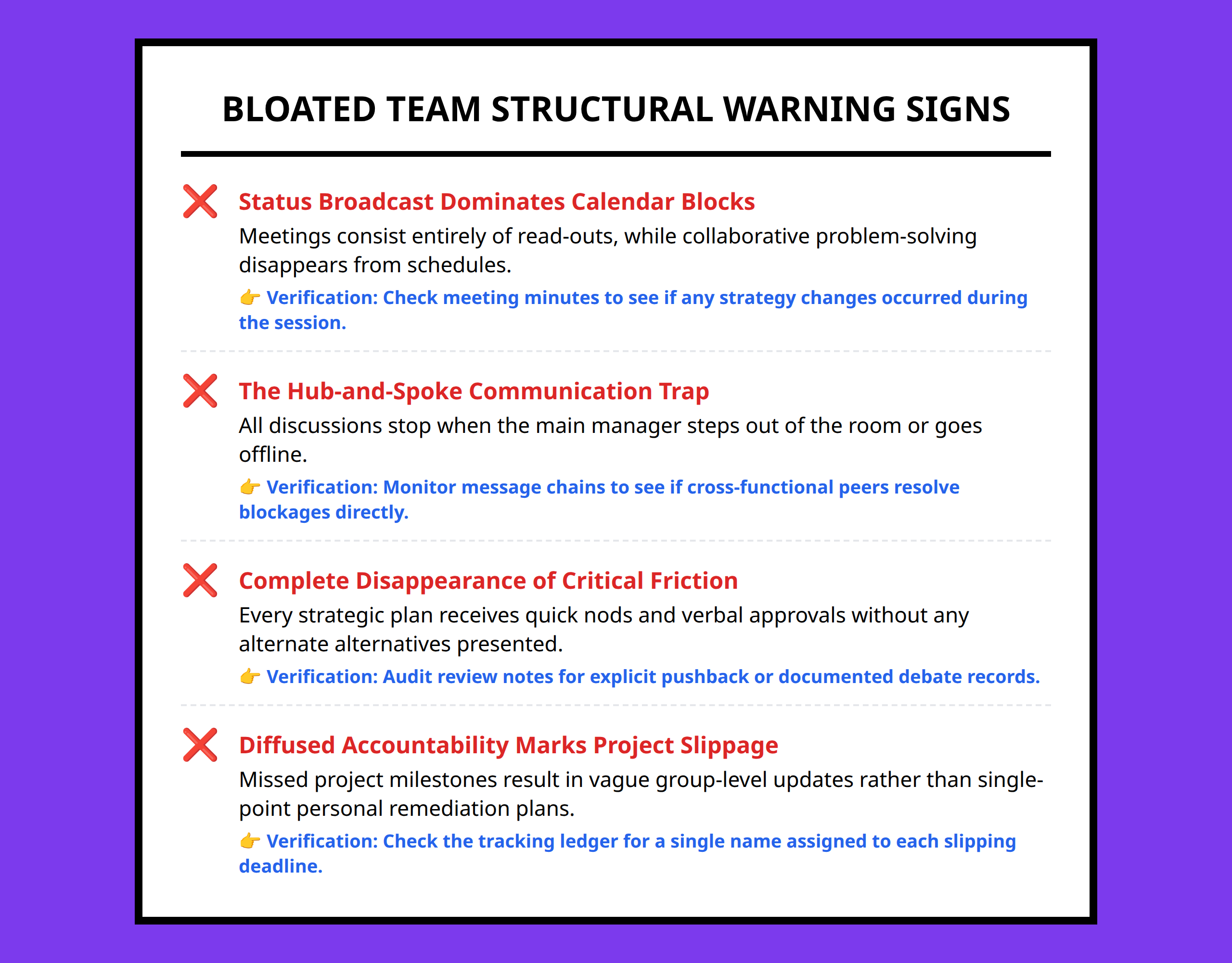
One of the least visible effects of oversized teams is the reduction of honest conversation.
As the number of participants increases, social exposure increases too. People begin managing perception more carefully. Public disagreement feels more consequential. Challenging a colleague openly may appear politically risky or unnecessarily confrontational.
The result is often polite silence rather than genuine alignment.
This matters because strong teams depend on visible challenge. Strategic mistakes become harder to detect when people stop testing assumptions openly.
Several warning signs usually emerge:
- important disagreements happen privately after meetings
- questions become cautious and indirect
- participants avoid interrupting weak reasoning
- consensus appears unusually fast on complex issues
- meetings feel controlled rather than exploratory
The mistake I would avoid here is assuming that calm meetings automatically indicate healthy collaboration. In many cases, excessive smoothness is actually evidence that people have stopped engaging honestly.
Example: Silent Agreement During Strategy Reviews
A senior team reviews a major operational proposal. Several members privately believe the timeline is unrealistic, but nobody challenges it openly during the meeting because the group is large, senior, and politically visible.
Concerns surface later through side conversations and implementation delays instead of direct discussion when the decision could still be improved.
The team avoids tension temporarily but creates greater operational friction later.
Large Teams Weaken Accountability in Predictable Ways
Accountability changes dramatically as team size expands.
In smaller groups, missed commitments become highly visible because interdependence is clearer. Team members notice when preparation is weak or follow-through disappears.
Large groups dilute that visibility.
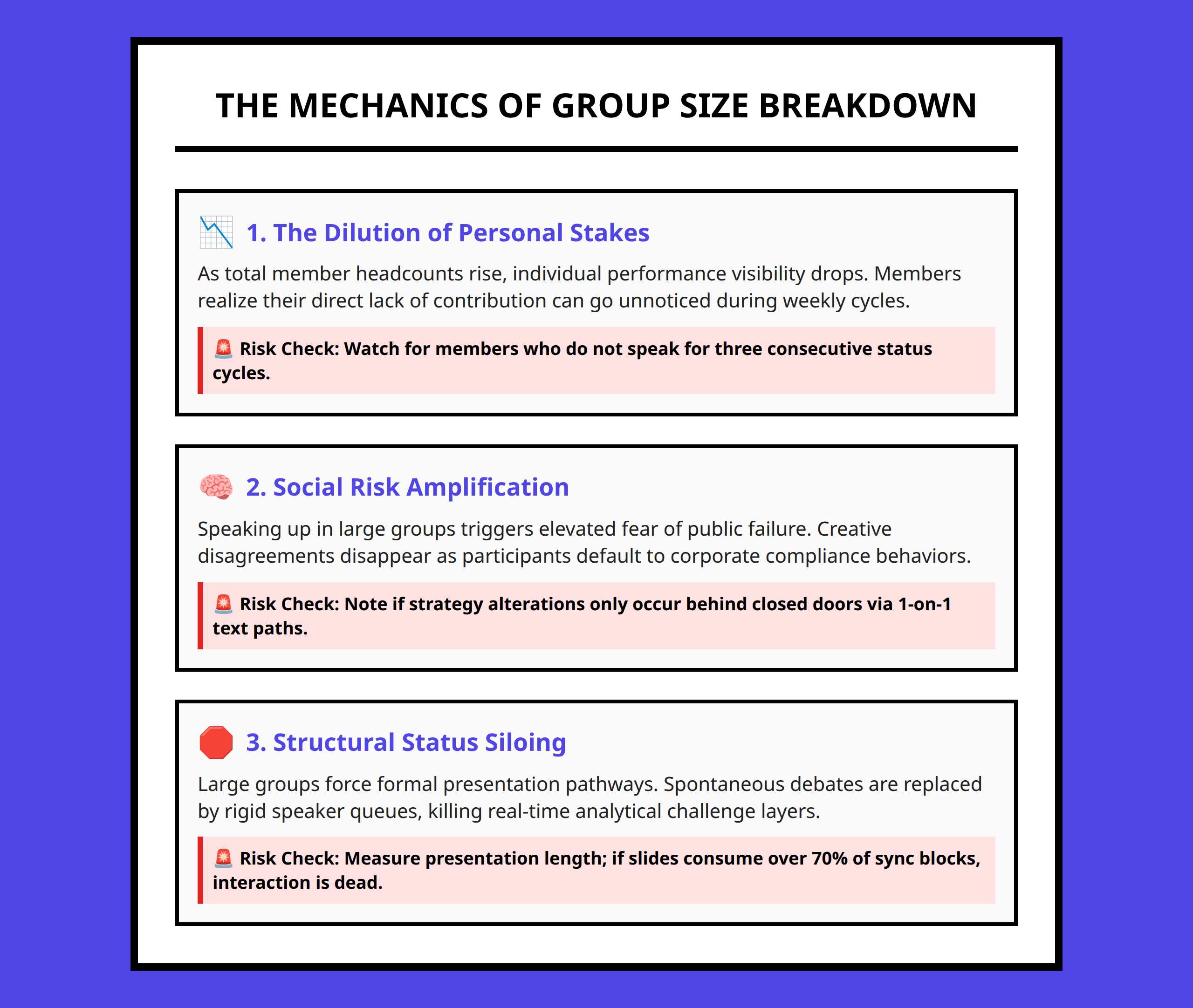
Responsibility becomes distributed across many participants, making it easier for individuals to disengage partially without immediate consequences. Attendance replaces contribution as the primary signal of participation.
This is one reason oversized meetings often generate extensive discussion but limited execution clarity.
People leave the room with different interpretations of ownership, priorities, and next steps because genuine alignment becomes harder to maintain across many participants.
Example: Cross-Functional Project Committees
A large project committee may include representatives from product, engineering, legal, operations, finance, compliance, and customer support.
Everyone participates in discussion, but ownership becomes fragmented. Tasks move slowly because multiple stakeholders expect someone else to coordinate the next step.
No single failure appears catastrophic, yet the overall pace of execution steadily declines.
Psychological Safety Shrinks as Exposure Expands
Psychological safety is often discussed abstractly, but team size affects it very directly.
In smaller groups, people usually feel more comfortable admitting uncertainty, asking naive questions, or challenging assumptions because the social environment feels manageable and familiar.
Larger groups increase perceived exposure.
People become more conscious of hierarchy, reputation, and impression management. That pressure naturally pushes communication toward safer and more conventional contributions.
I would not treat this as purely a cultural problem. Even strong organizational cultures struggle to maintain deep psychological safety once meetings become too large and socially complex.
This explains why some organizations mistakenly interpret silence as agreement. Often, silence simply reflects reduced willingness to take interpersonal risk in crowded environments.
How to Recognize When Team Size Is Hurting Performance
Leaders often notice the symptoms of oversized teams before recognizing the structural cause.
A few practical diagnostic questions can help:
- Do only a small percentage of attendees contribute consistently?
- Are decisions revisited repeatedly outside the main meeting?
- Do conversations feel presentation-driven instead of collaborative?
- Does the leader dominate coordination between members?
- Are disagreements surfacing privately instead of publicly?
- Do participants attend mainly for visibility or awareness?
If several of these patterns appear together, team size is probably degrading interaction quality.
Reducing Team Size Is Not About Exclusion
One common misunderstanding is that smaller teams automatically reduce inclusion or transparency. In practice, the opposite can happen.
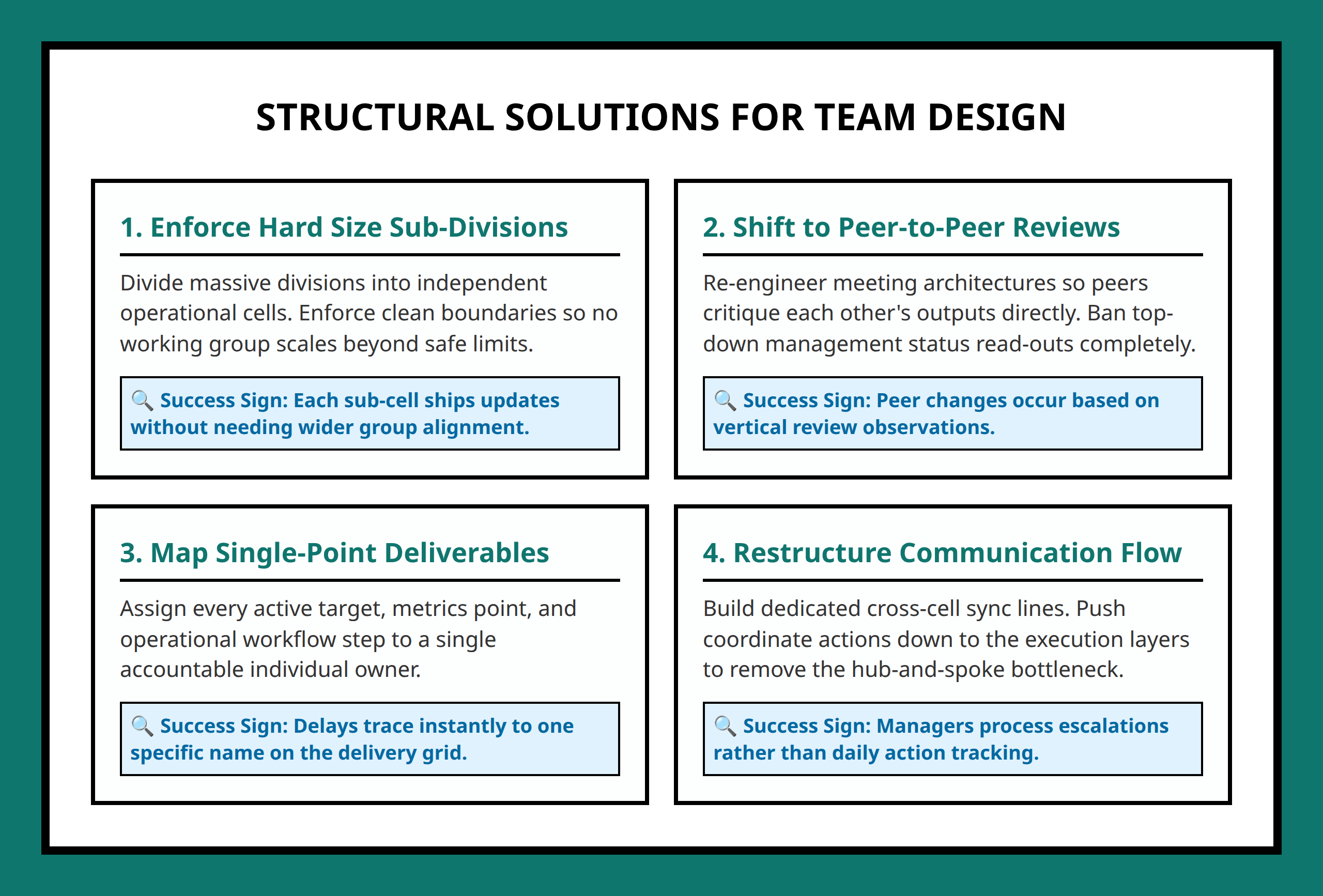
Smaller operational teams often create clearer ownership, faster feedback loops, and more direct discussion. Broader stakeholder visibility can still happen through summaries, asynchronous updates, or targeted participation when needed.
The key distinction is between involvement and attendance.
Not everyone needs to be inside every collaborative discussion for an organization to remain aligned.
The practical question leaders should ask is not:
Who might want to attend this discussion?
but:
Who genuinely needs to participate for the team to think, challenge, and decide effectively together?
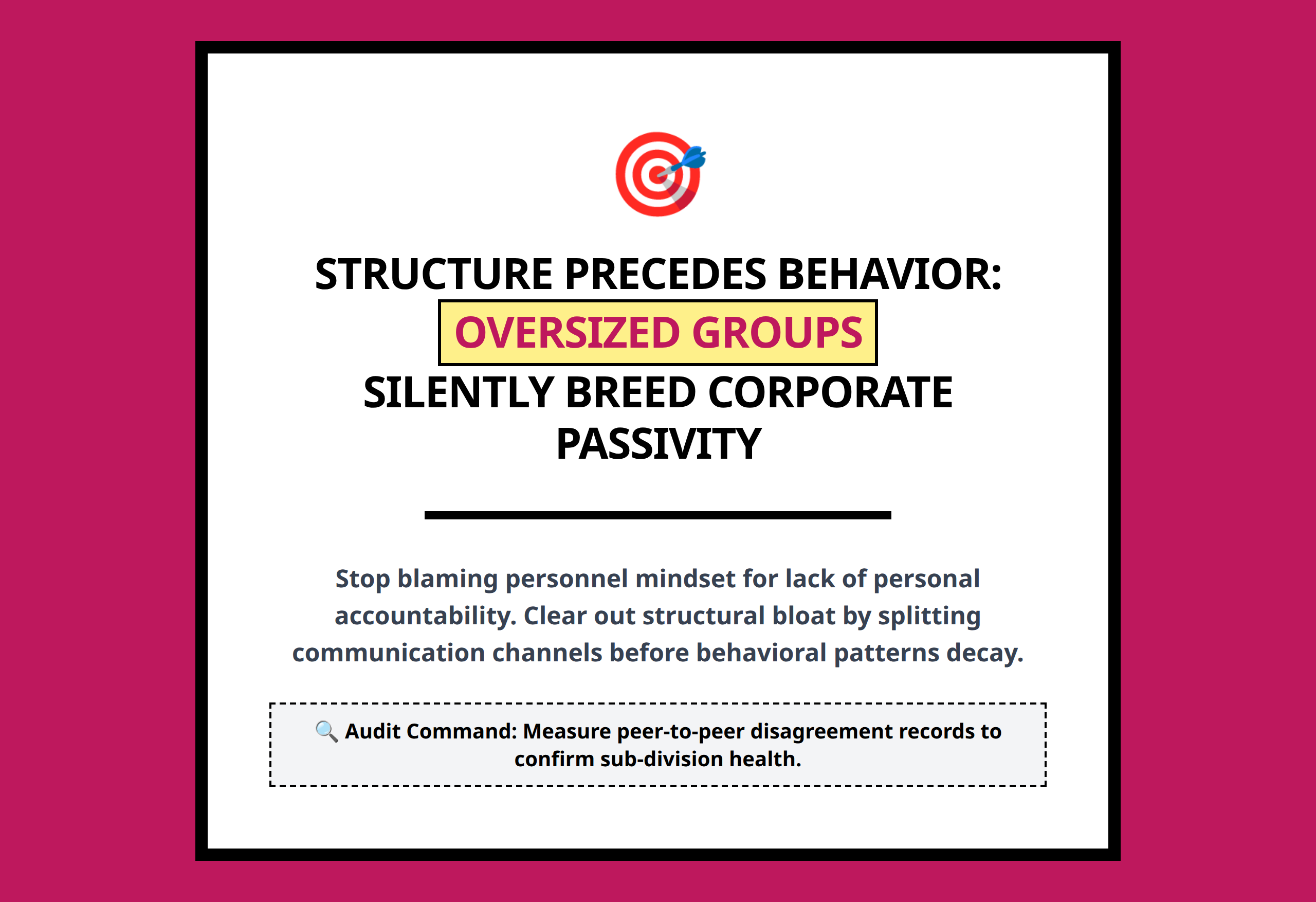
Once that distinction becomes clearer, many organizations begin realizing that their collaboration problems are not caused by insufficient communication. They are often caused by too many people trying to collaborate simultaneously inside the same room. fileciteturn7file0
References:
- https://www.linkedin.com/posts/goiyerthecoach_careershifts-leadership-teameffectiveness-activity-7415199391193636866-UIFx
- https://www.smartbrief.com/original/three-things-killing-your-team-conversations-and-how-to-fix-them
- https://engageforsuccess.org/3-empathy-frameworks-that-can-boost-team-accountability/
- https://medium.com/@wernerotto/why-high-performing-teams-fail-when-leaders-confuse-accountability-with-blame-f7d5944c7ab5
- https://www.linkedin.com/posts/keithferrazzi_after-23-years-of-coaching-executives-ive-activity-7441188432602836992-lftI
- https://zengerfolkman.com/articles/trust-breakers-8-leadership-mistakes-that-destroy-team-confidence/
- https://www.gemmabrowncoaching.co.uk/post/the-quiet-cost-of-silence-in-teams
- https://boldclarity.com/blog/the-importance-of-having-a-will-what-you-need-to-know
- https://centrical.com/resources/what-are-the-five-cs-of-leadership-and-team-accountability/
- https://www.scribd.com/document/891850715/7-Silent-Killers-of-High-Performing-Teams
- https://medium.com/@jomabeelein/4ds-for-avoiding-accountability-ab0705f50c35