The Industrial Revolution did more than introduce machines into production. It reorganized work itself by separating tasks, reducing worker autonomy, centralizing control, and building a labor system designed around machines instead of craftsmanship.
When people talk about the Industrial Revolution, the conversation usually stays at the level of inventions. Steam engines. Textile mills. Mechanized looms. What interests me more is the quieter change underneath those inventions: the way work itself was reorganized.
Before industrialization, many workers controlled the pace, method, and quality of their own labor. After industrialization, work increasingly revolved around machines, schedules, supervision, and repetitive specialization. That shift still shapes modern workplaces, including today’s debates around AI and automation.
I think this matters because people often assume automation replaces workers directly. Historically, the larger change was often structural. Technology changed how labor was organized before it fully changed who performed the work.
Takeaways
- The Industrial Revolution reorganized labor around machine efficiency, not worker autonomy.
- Factory systems broke complex crafts into narrow repetitive tasks.
- Managers gained more control as workers lost ownership of the full production process.
- Many modern automation debates repeat patterns first seen during industrialization.
Work Before Factories Was Local, Skilled, and Personal
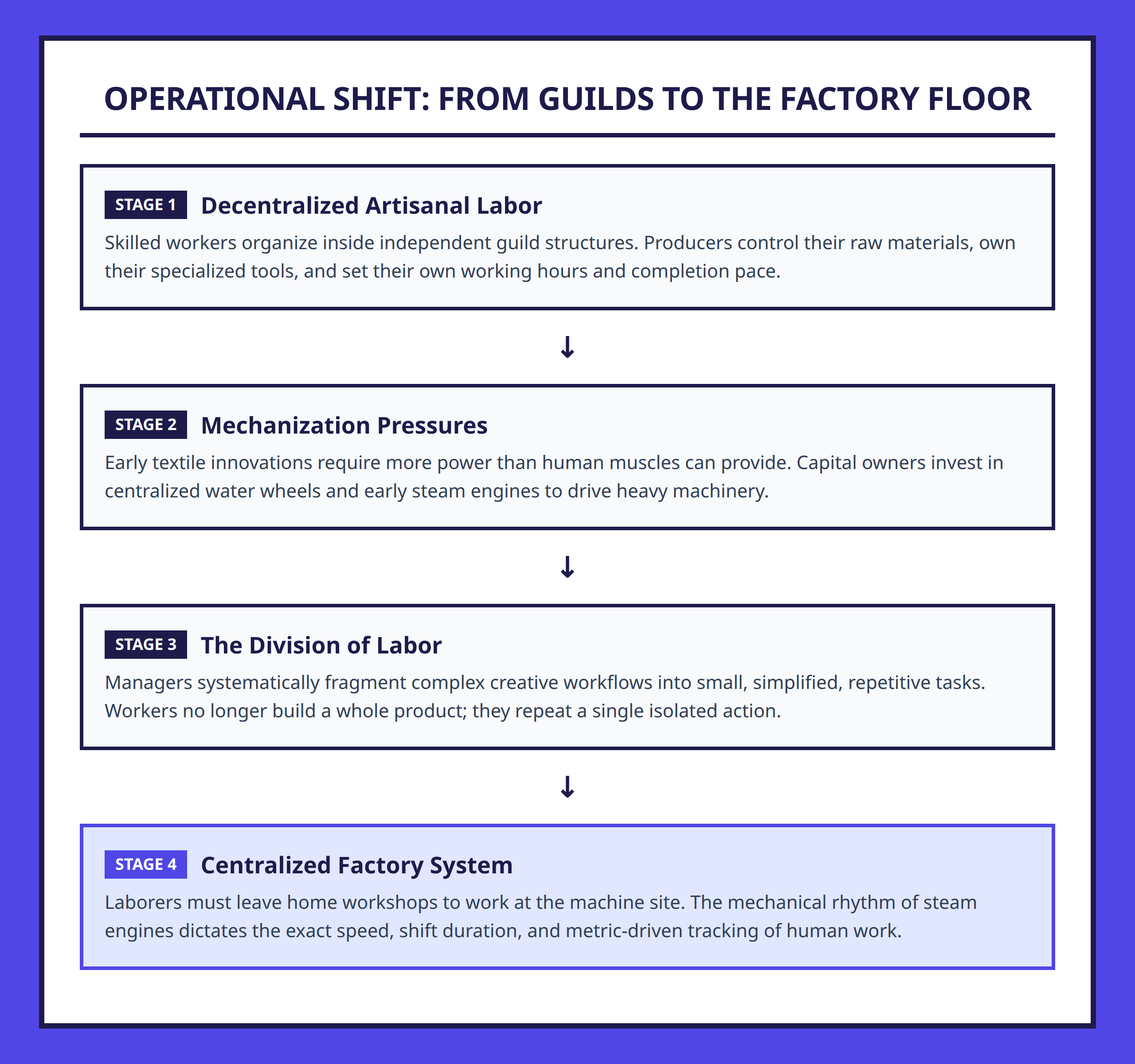
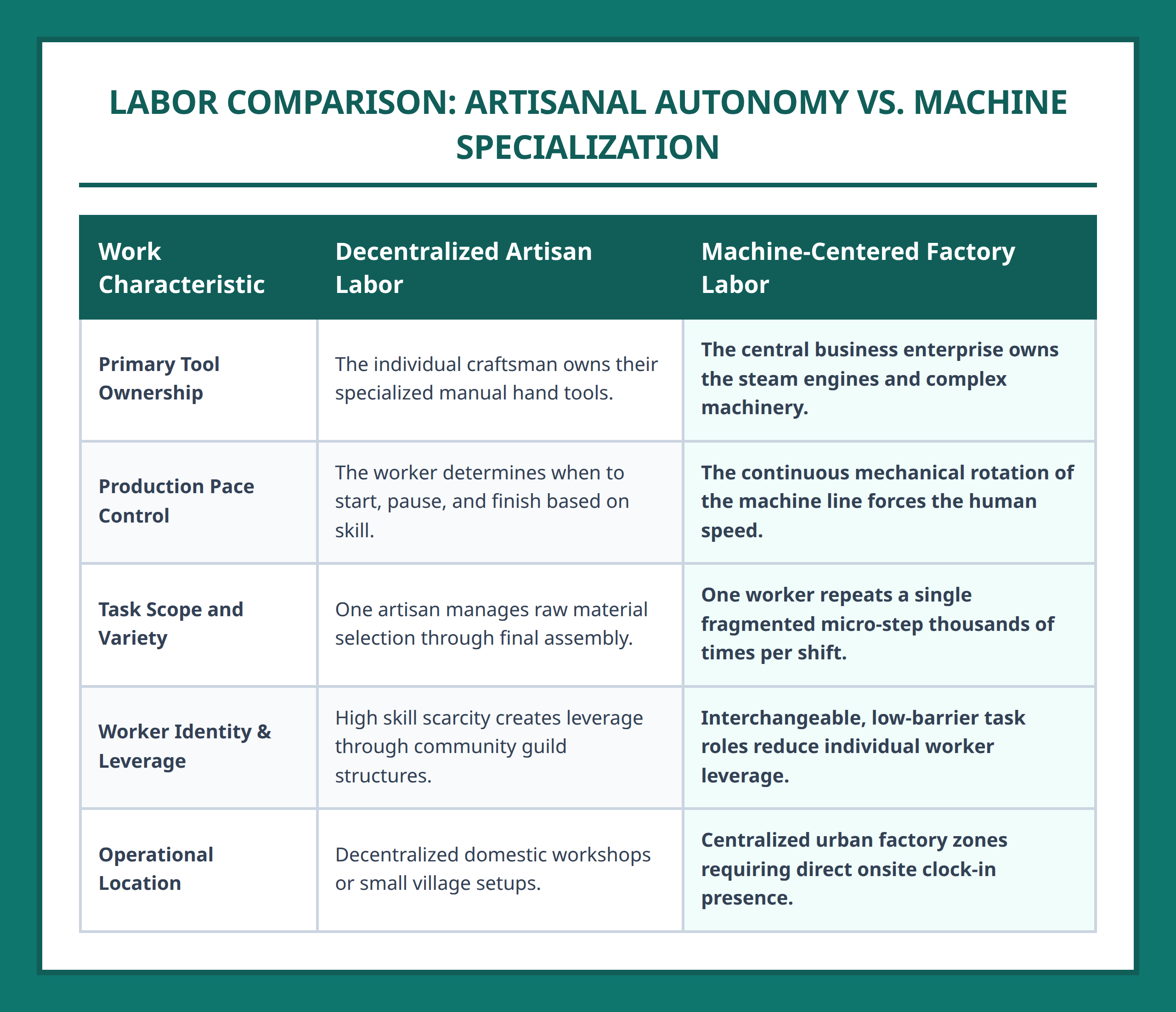
Before mechanized factories became dominant, much production happened in homes, workshops, and small urban craft spaces. Skilled artisans often controlled the full process of making goods. A cloth maker, metalworker, or furniture maker usually handled multiple stages of production rather than one isolated task.
Guild systems reinforced that structure. In many European cities, guilds regulated who could enter a trade, how products were made, and what quality standards had to be followed. Apprenticeships could last years because workers were expected to master entire crafts, not just fragments of them.
That older structure had limits. Production was slow. Scaling was difficult. Guild restrictions often blocked competition and experimentation. Still, workers usually retained a stronger connection to both the process and the finished product.
I think this is the part modern discussions sometimes overlook. Pre-industrial labor was harder physically and less productive economically, but workers often had more control over the rhythm and identity of their work.
A simple example helps make the contrast clearer. Imagine a shoemaker working from a small shop. The same person measures materials, cuts leather, assembles the shoe, checks quality, and sells the final product. The knowledge stays with the worker.
Factory systems changed that relationship completely.
Machines Changed Production Before They Changed Employment
The Industrial Revolution accelerated when machines began outperforming manual production in speed and consistency. Textile manufacturing became one of the clearest examples.
Machines such as the spinning jenny, water frame, and power loom dramatically increased textile output. A process that once depended on highly skilled manual weaving could now be divided into smaller machine-supported tasks.
The steam engine pushed this transformation even further because factories no longer depended entirely on rivers or local water power. Production could move into centralized urban factories where machines operated continuously.
The important point is that machines did not immediately eliminate human labor. They reorganized it.
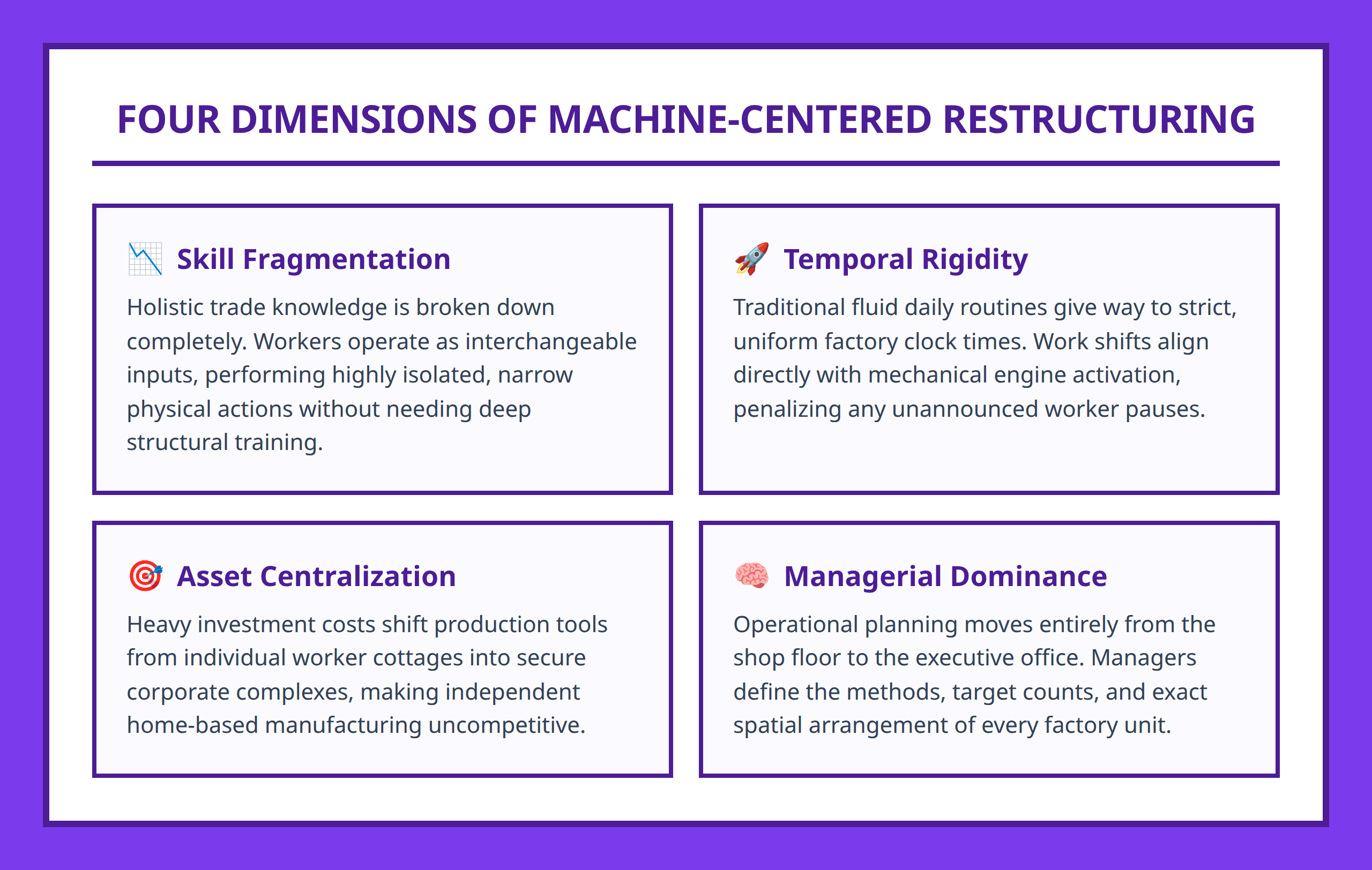
Factories still needed workers. What changed was the worker’s role inside production. Instead of overseeing an entire craft process, many workers became responsible for one narrow repetitive activity tied to a machine.
That distinction matters. The factory owner increasingly controlled the system while workers operated inside it.
The Division of Labor Fragmented Skilled Work
One of the defining changes of industrialization was the fragmentation of complex work into smaller specialized tasks.
Economic thinkers such as Adam Smith described how dividing labor into separate steps increased efficiency. Industrial factories applied that principle aggressively.
Instead of one worker building a full product, production was broken into sequences:
- One worker fed raw material into a machine.
- Another monitored output.
- Another repaired equipment.
- Another assembled components.
This specialization increased productivity because workers repeated the same action continuously. Training became faster. Production became more standardized. Factories could scale output far beyond artisanal workshops.
But there was also a human tradeoff.
Workers often lost visibility into the larger production process. Knowledge became concentrated in managers, engineers, and factory owners rather than distributed across craftsmen.
I would pay attention to this pattern whenever new automation systems appear today. The key shift is often not replacement first. It is separation. Systems isolate tasks, simplify workflows, and reduce the amount of judgment individual workers need to apply.
Factories Shifted Power Toward Owners and Managers
As production centralized, managerial power expanded.
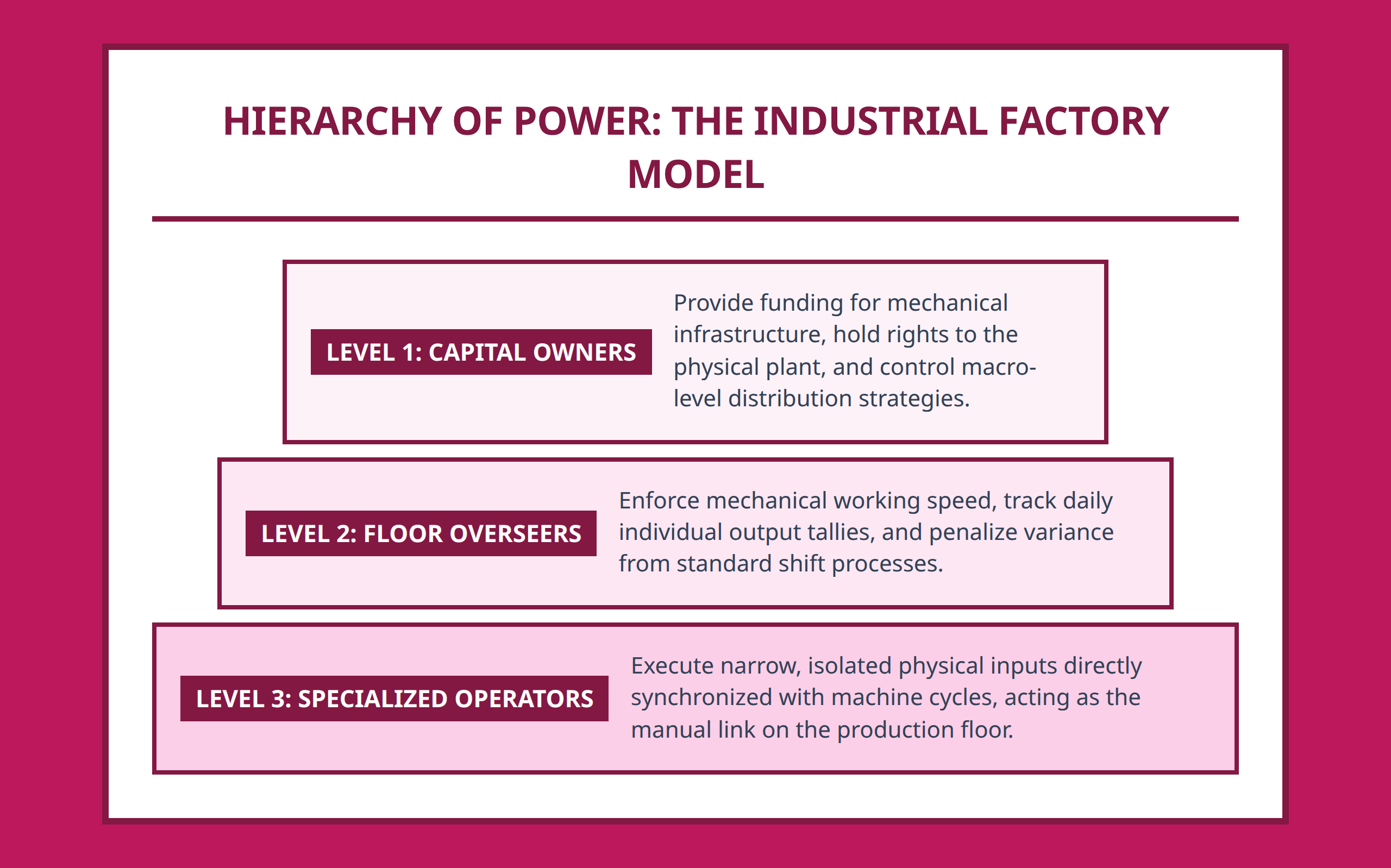
In craft systems, skilled workers carried much of the production knowledge themselves. In factory systems, the organization increasingly owned the machinery, workflow design, scheduling, and production logic.
That created a different kind of workplace hierarchy.
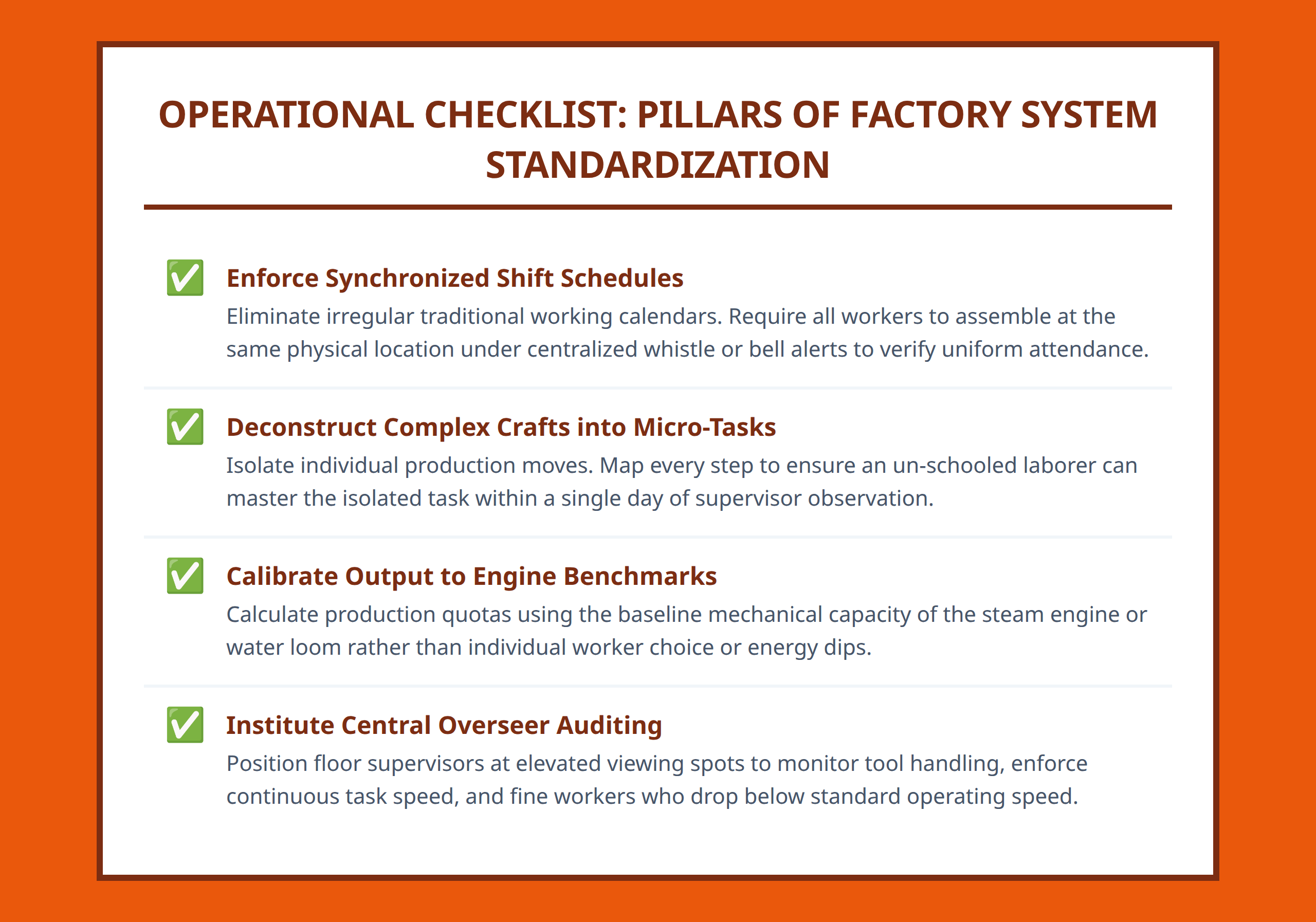
Workers followed standardized schedules tied to machine operation. Supervisors monitored output. Owners controlled expensive industrial equipment that individual workers could not realistically possess themselves.
The structure of labor became more dependent on capital investment and centralized coordination.
A modern reader can still recognize the pattern. Many workplaces today depend on software systems, dashboards, workflows, and platforms that employees operate inside rather than control directly.
I do not think the historical comparison means AI will repeat industrialization exactly. But the organizational logic feels familiar: technology concentrates coordination power while narrowing some forms of worker discretion.
Urbanization Was Also a Workplace Technology Story
Industrialization changed geography because factories changed where work could happen.
Before factories, production was spread across homes, farms, villages, and small workshops. Mechanized factories concentrated workers in cities because large machines, steam power, transportation systems, and centralized production all worked better together.
That migration reshaped daily life.
Workers left decentralized rural systems and entered environments with strict schedules, long shifts, and close supervision. Entire families often worked inside factories, including children in many early textile operations.
The human cost became visible quickly. Long hours, repetitive labor, dangerous machinery, and overcrowded industrial cities created pressure for labor reforms and worker protections.
I think this is another important correction to simplistic automation narratives. Productivity gains do not automatically improve working conditions. Organizational incentives matter. Power structures matter. Labor protections matter.
Industrialization Reduced Some Skills While Increasing Others
One mistake I often see is the idea that industrialization simply destroyed skill.
The reality was more uneven.
Factories reduced demand for certain artisanal skills because machines simplified parts of production. But industrial systems also created demand for mechanics, engineers, machine operators, repair specialists, supervisors, and logistics coordinators.
The workforce changed shape.
For example, a highly skilled weaver could lose economic power when machine-assisted textile production expanded. At the same time, factories needed people who understood machine maintenance and industrial coordination.
This pattern keeps repeating across technological transitions. Some skills lose leverage while others gain importance because the surrounding system changes.
That is why I think discussions about automation become more useful when they focus on organizational restructuring instead of simple job counts.
Why This History Still Matters in the AI Era
Modern AI debates often focus on whether machines will replace human workers entirely. The Industrial Revolution suggests a more complicated possibility.
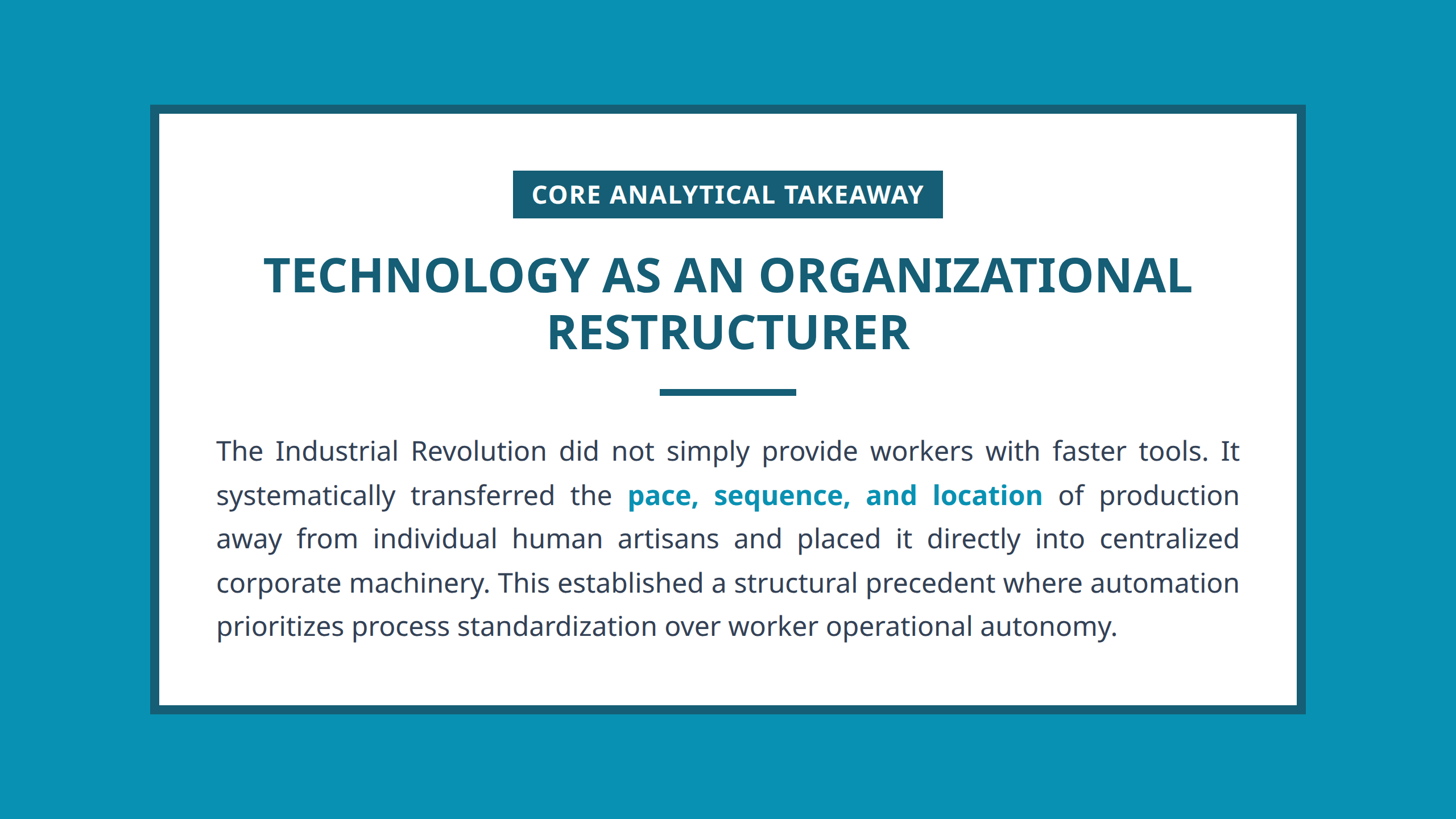
Technology often changes the structure of work before it fully changes employment levels.
A customer service employee may still exist after automation, but their role could shift from solving problems independently to supervising AI-generated workflows. A designer may still work, but inside systems that standardize parts of the creative process. A manager may rely more heavily on analytics systems that shape decisions before human judgment enters the picture.
The historical pattern is not just about machines replacing muscles. It is about systems reorganizing labor around efficiency, coordination, and scalability.
I think that is the deeper lesson from industrialization. The most important workplace changes often happen quietly inside workflow design, specialization, supervision, and organizational control.
By the time people notice the cultural consequences, the labor structure has already changed.
- Guild: An organization that regulated skilled trades in pre-industrial societies, including training, quality standards, and entry into the profession.
- Division of labor: Breaking production into smaller specialized tasks performed by different workers.
- Factory system: A centralized production model where workers, machines, and materials operate together under coordinated supervision.
- Steam engine: A machine that converts steam power into mechanical energy, allowing factories to operate at larger scale and in more locations.
- Mechanization: Replacing manual labor with machines to increase speed, consistency, and production scale.
- Artisanal labor: Skilled manual work where one worker often controls most or all stages of creating a product.
- Specialization: Focusing workers on narrow repetitive tasks rather than full production processes.
- Automation: Using machines or software systems to perform tasks previously done by humans.
References:
- https://www.britannica.com/story/the-rise-of-the-machines-pros-and-cons-of-the-industrial-revolution
- https://www.aspectpt.com/industrial-revolutions-the-rise-of-the-machines-and-the-role-of-the-humans/
- https://education.nationalgeographic.org/resource/industrialization-labor-and-life/
- https://big-agile.com/blog/the-past-and-future-of-machines-taking-over-human-jobs
- https://cfhorgan.medium.com/the-rise-of-human-machines-cc1bbfa97b78
- https://www.oerproject.com/OER-Materials/OER-Media/Videos/WHP-1750/Unit3/Unit-3-Overview
- https://www.youtube.com/watch?v=f4myjK2XoU8
- https://www.youtube.com/watch?v=qMQvfN0psQA
- https://www.reddit.com/r/AskHistory/comments/1j25i7g/was_human_power_used_to_operate_machines_in_the/
- https://www.reddit.com/r/AskHistory/comments/1j25i7g/was_human_power_used_to_operate_machines_in_the/mfp668g/
- https://economics.mit.edu/sites/default/files/2024-10/LearningfromRicardoandThompson-MachineryandLaborintheEarlyIndustrialRevolution-andintheAgeofAI.pdf
- https://www.functionly.com/orginometry/the-ai-revolution/lessons-from-the-industrial-revolution-we-should-apply-to-ai-integration
- https://library.si.edu/exhibition/fantastic-worlds/rise-of-the-machines
- https://www.studentsofhistory.com/impact-of-the-industrial-revolution
- https://www.law.georgetown.edu/denny-center/blog/industrial-revolution/
- https://www.sciencedirect.com/science/article/pii/S2093791119304056